

The Success Trap
October 13, 2026 7:30 am
When the Habits That Built Your Career Begin to Limit Your Leadership
By Doug Filter & Shannon Holland, DNP
There was a time when your ability to solve problems was one of your greatest strengths.
You answered the difficult questions. You stepped into struggling departments. You filled gaps, handled problems, stayed late, and made sure the work got done.
People learned they could depend on you.
Those habits earned trust, strengthened your reputation, and helped open the door to your first leadership opportunity.
Then came another promotion. And another.
Your responsibilities grew, your span of control expanded, and the problems became more complex. More people looked to you for answers.
But the biggest change was not the promotion; it was the definition of success.
The very definition of success changed.
As we advance, operational performance still matters, but our highest value comes from creating clarity, growing leaders, anticipating what is ahead, and preparing the organization for what comes next.
Yet when pressure increases, we can instinctively retreat to the work that once made us successful.
We go back to solving and fixing. We jump into the weeds.
Tactical work feels productive because it is familiar, concrete, and easy to measure. Strategic leadership often takes longer to see.
And that’s where the success trap begins.
When the Scorecard Changes
In a recent coaching conversation, a CEO described how he had historically measured his success:
“I measured my personal success by how many things I could personally cross off my task list.”
For much of his career, that measure served him well. He was capable, responsive, dependable, and willing to take responsibility. Those qualities helped earn trust and contributed to his advancement.
Then the role changed.
The organization no longer needed him to personally complete more tasks. It needed him to create a clear vision, communicate it consistently, develop the leaders around him, and protect enough margin to think about what was coming next.
The scorecard that once affirmed his effectiveness was now pulling him away from the work only he could do.
Many leaders have heard some version of the familiar reminder, “What got you here won’t get you there.”
The harder question is:
What should I stop measuring, stop doing, or start developing in others?
Growing Pains
One of the most difficult leadership transitions is going from manager to director. From leading the front line directly to becoming a leader of leaders. The thought process is very different.
Directors must increasingly lead through the managers closest to the work. The C-level executive’s role is more like conducting the full orchestra rather than leading a single section.
 The shift may sound simple, but in practice, it is much harder than it seems. When a problem surfaces, experienced leaders often know exactly what to do. Jumping in can feel faster, safer, and more efficient.
So, with good intentions, they jump in.
The motivation is understandable. The issue may feel too important to ignore; the manager may be struggling; or the leader may simply know they can solve it faster.
Each time a senior leader steps past a manager and directly into the work, an important question follows:
What did that decision (intentional or not) just teach everyone involved?
Did we unintentionally signal that we do not fully trust our managers to handle difficult situations? Are we teaching the team to wait for us to step in? And if we are honest, being the person everyone depends on can feel good, at least until everyone depends on us.
In the meantime, our managers lose opportunities to wrestle with difficult problems, make decisions, learn, and grow.
By “helping” solve today’s problem, we may unintentionally make tomorrow’s leadership challenge a little bigger.
The Trap Has Sprung
The trap springs when our responsibilities continue to expand, but our approach to leadership does not evolve along with them.
We keep measuring ourselves by how much we personally solve and produce, even as the role increasingly requires us to create clarity, develop leaders, and prepare the organization for the future.
This does not mean senior leaders should avoid tactics or operational details altogether. At times, they absolutely should.
The distinction is intentionality.
Am I getting involved because this is truly the best use of my time, or because it feels easier to do it myself?
That can be a difficult distinction to see from inside the pressure of the moment. The trap rarely looks like failure.
In fact, it can feel like the opposite: “I’m busy, I’m responsive (checking email at 11 PM), I’m helpful, and things are getting done.”
Over time, immediate demands can crowd out strategic thinking. Managers become more dependent than capable. Vision gets discussed occasionally rather than communicated consistently. Decision-making remains concentrated in a few people instead of being distributed across the organization.
We may even continue to perform at a high level for a period of time, but at what cost?
When we spend time doing work others could learn to do, we reduce the capacity we need for the strategic work only we can do.
Good Luck
And, while the expectations increase with each new role, the preparation for success doesn’t always keep pace.
Too often, the message is simply: “Congratulations! Now go do great things.” Then the leader is left to figure it out alone.
A new role often requires more than new responsibilities; it requires a new way of leading. The best leaders recognize that they must actively own their development.
With each new level of responsibility, we must decide what to continue, what to change, and what to let go.
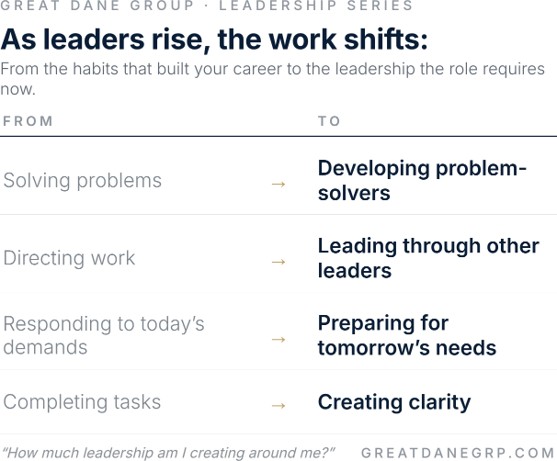
These shifts do not remove operational accountability; they clarify where a leader’s time, attention, and experience are most valuable.
Eventually, the leadership scorecard changes. The defining question changes. It is less about:
How much can I personally accomplish?
And more about:
How much leadership am I creating around me?
Creating the Capacity to Lead
When we build leadership capacity around us, we also create capacity within ourselves.
Strategic leadership requires margin, but in a culture that often celebrates busyness, we may have unintentionally removed what leaders need most: time to think.
Developing leaders takes time. Asking good questions takes time. Allowing someone else to wrestle with a problem often takes longer than solving it yourself. But that is the investment: as others become more capable, we create more space for the work only we can do.
Same Experience. Different Approach.
Your tactical expertise still matters. The opportunity now is to apply it differently: not only by knowing the risks, pitfalls, and landmines, but by helping others learn to see and navigate them.
Leadership is not measured by how indispensable we become. It is measured by how much leadership we create around us.
About The Authors

Doug Filter

Shannon Holland, DNP
Doug Filter and Shannon Holland, DNP are executive coaches with Great Dane Group. They work alongside leaders and teams to create clarity, build leadership capacity, and navigate the challenges that come with leading people and organizations.

Comments are closed here.